A REFLECTION ON 30 YEARS OF MARRIAGE
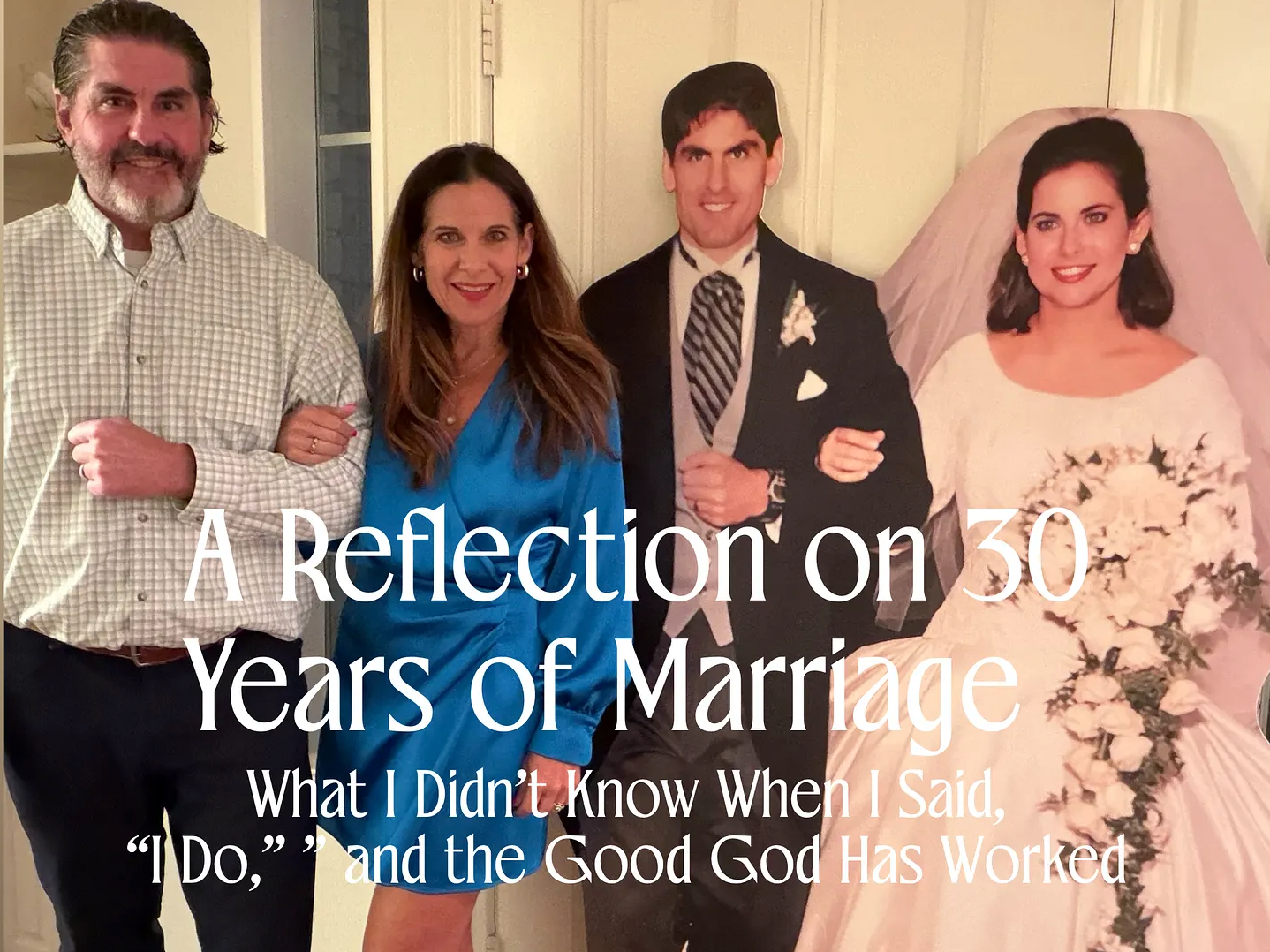
What I Didn't Know When I Said, "I Do," and the Good God Has Worked
On a hot summer afternoon, I laid on my bed wanting nothing more than to not be needed or have to be on. I was a thirty-something pastor’s wife with three young children and a college student living with us. Outside my bedroom window, I could hear them all in the backyard. I knew they were waiting on me to go to the pool. I couldn’t stay hidden, but I wanted to escape!
I was resentful that my husband could just escape into the world of college students and fun while I handled constant chatter, discipline, cooking and cleaning on top of my work-from-home job that was at times demanding. At that time, I was still posing as the perfect wife and mother so I would’ve never let anyone know things felt hard.
It was a season. But even in easier seasons, marriage takes committed work because those vows we take on our wedding day aren’t based on feelings of the moment. Rather, they are a future-oriented promise ten, fifteen, thirty years and beyond to love, cherish and endure in the unknown “better or worse” we say “I do” to.
Though in this way we step into marriage blindly, not knowing what exactly what we’ve said “yes” to, nothing is a surprise to God. Not only that but he ordained marriage to reflect his love for his church, and to grow us in Christ-likeness. So, in reflection this week of THIRTY YEARS of marriage, I shared on Instagram a reel of eight things I didn’t know when I said, “I do” and how our covenant-keeping God has kept us. Below is an elaboration.
What I Didn’t Know and the Good God Has Worked
1. How Selfish and Sinful I Really Am —> My Deep Need for Jesus
As a believer, I knew I was a sinner but until marriage where I constantly bumped up against my desires vs his, did I see how selfish I really am. In this way marriage serves as a mirror for revealing sin. The more I’ve seen my sin, the more I’ve come to see my deep need for Jesus—for forgiveness, but also help in dying to living-for-myself desires.
2. What “Better or Worse” Would Be —> Sanctification through Sin, Trials and Suffering
As I mentioned above, when we say “I do” we have no idea what our future holds. No idea what better or worse may be. But scripture is clear that we will have trials: “Do not be surprised at the fiery trial when it comes upon you to test you, as though something strange were happening to you (1 Peter 4:12).” Normal life is not a perpetual honeymoon. We should expect hard. Even so, hard is never easy but God is still good.
Today, my husband and I are not who we were thirty years ago, even five years ago, and in five more years we will not be as we are now. God works through adversity to sanctify (or grow) us in Christ-likeness, one degree to the next until glory. This is the good God is working in those who love him (Romans 8:28). It takes the trials to refine us; if all was easy, we wouldn’t grow in the ways he wants for maturing us. And I can honestly say, I wouldn’t undo the good that has come out of hard things we’ve faced.
3. What oneness entails in the day-to-day —> The growing together in unity
At the pronouncement of a couple as husband and wife, “they are no longer two but one flesh (Matthew 19:6).” This is not simply a physical union, but a oneness of shared purpose, a joined life in every sense. Only I didn’t always feel united. In some ways this relates to sinfulness but also stems from our different personalities, interests, and backgrounds. As time as gone on though, we’ve melded together. We know more how each other thinks and feels influencing how we think and what we do in consideration of one another, which brings great unity
4. The ongoingness of redemptive living —> Learning humility and growing in grace
The fact we are two sinners living together means we will always contend with sin. We won’t overcome it. So instead of pridefully pretending otherwise, trying to cover up, or self-justify (though that still happens!), with time and grace has come more humility in admitting when we’re wrong. And with humility, a quickness to enter again into the cycle of confession, repentance, forgiveness and grace that will continue until glory.
5. What it is to depend on Jesus in all things —> Becoming less self-sufficient
We prize self-sufficiency but neither the Christian-life or marriage is designed for independence. So going hand-in-hand with seeing my deeper need for Jesus is learning dependance on him for everything I am not. For example, in my annoyance I need Jesus to grant me his patience. In my unwillingness to let go of a grudge, I need Jesus to work forgiveness in me. In my anxiousness, I need Jesus to give me his peace. On my own I can’t or won’t, so I turn to Jesus more than I once did.
6. How maturity would change what we care (and don’t care about) —> Less critical andgreater contentment
In the earlier years pretenses mattered more. I wanted my husband to conform to the likeness I had for him. I cared more about others’ opinions and how I presented to the world. This led to striving and perfecting with a critical, discontent heart. Not all the time, but as we’ve grown (or I’ve grown) God has freed me. On the introduction page of my website, I talk about this as a joyous contentment that grace has given.
7. How hard parenting would be —> Learning to rest in God’s control
Every parent knows parenting is hard. Just how hard came for me when I could no longer fix or change the various struggles and trials my kids faced as teenagers and young adults. This hard brought my husband and I together in a way that ease doesn’t do. Only he understood and felt the same depth of emotion I did about our kids, and this drove us together in prayer and quiet comfort no one else could provide. But it also became the impetus to learning to rest in God’s control, which extends into every realm of life, not just parenting.
8. The security of a covenantal relationship —> Seeing the worst-version of the other person and being committed to love anyway
When we say our vows, we covenant ourselves to one another in the way God covenanted himself to his people. It is a permanent, unconditional, faithful love we say “I do” to. I knew this, but the beauty and security of it becomes greater with time. Just as we become more in awe of God’s love as we see more of our unworthiness of his love, the same is true in marriage. The sin and selfishness, the quirks, the parts of each other we wish we could change may remain, and yet the longer we stand by the other’s side committed to not going anywhere, the more secure and grateful we become.
- - -
And did you know, research shows that couples who make it beyond twenty years and into emptynesterhood experience increased happiness with age? This isn’t because we’ve stopped sinning, dropped bad habits, addressed annoying pet peeves or mastered our spouse’s love language. Rather, I suspect what I have found to be true is true of others married for this length and longer. If I had to sum it up in just one sentence, it’s this: By God’s grace I think more now about we than me, and trust more in He than me than I did thirty years ago!
Together Growing in Grace,
Kristen
